Have you ever considered how a simple tool can transform your understanding of weight and force? A spring scale, with its straightforward mechanics, opens up a world of insights into measurement.
What You Will Learn
- The basic mechanics of a spring scale and its components, including the hook, spring, and scale dial.
- How Hooke’s Law explains the relationship between weight and the extension of the spring.
- The significance of gravity in accurate weight measurements and how altitude affects these readings.
- Practical applications of understanding spring scales in everyday life and educational settings.
The Mechanics of a Spring Scale
A spring scale is a handy tool that measures weight or force through the tension of a spring. At its core, this device operates on simple yet effective principles, making it an essential instrument in various settings, from classrooms to laboratories. Whether you’re measuring the weight of a fruit or the force needed to lift an object, understanding how a spring scale works can enhance your accuracy and efficiency!
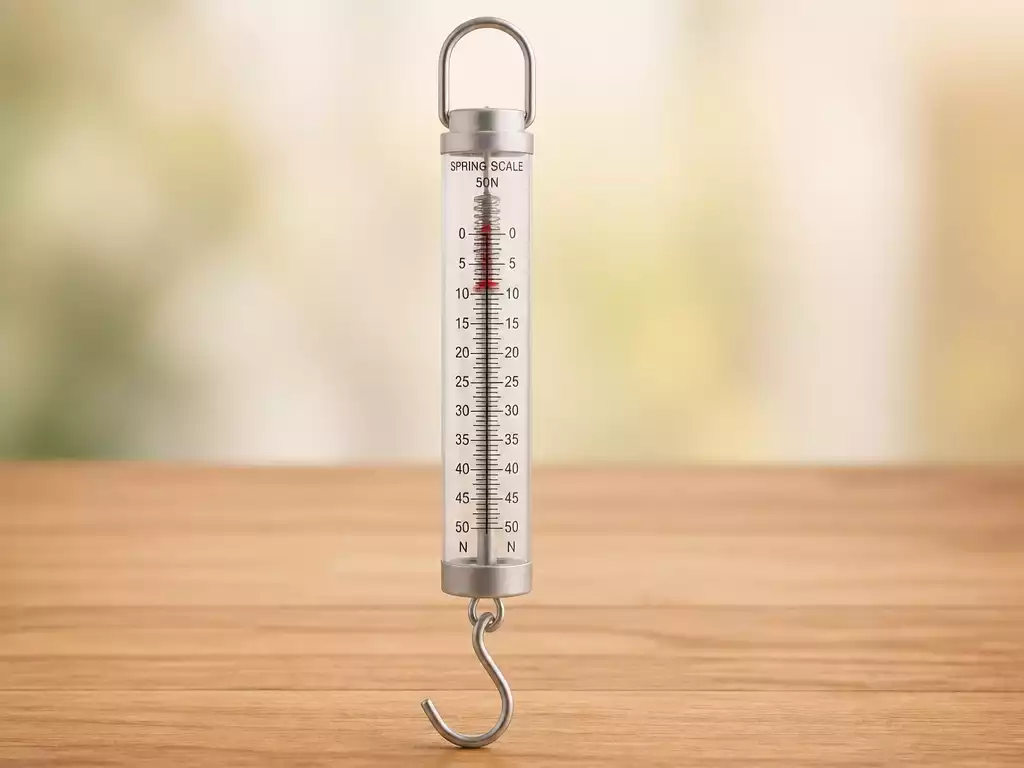
The primary function of a spring scale is to convert the force applied to it into a readable value, usually in grams or pounds. This conversion is achieved through the stretching of the spring within the device. As the object being measured exerts force, the spring extends, and the scale indicates this extension on its dial.

Defining a Spring Scale: What It Is and How It Works
Let’s dive deeper into what makes a spring scale tick! Essentially, when an object is hung from the scale, the gravitational force pulls down on it. This force stretches the spring inside, and the extent of this stretch correlates to the weight of the object. The greater the weight, the more the spring elongates.
- Hook: This is where the object is attached, allowing for easy measurements.
- Spring: The fundamental component that stretches under load.
- Scale Dial: Displays the weight based on the position of the spring.
Understanding these components can help you appreciate how this simple yet effective tool functions! As a user, knowing how to interact with these parts can lead to more precise measurements and better results.
The Science Behind Spring Scales: Hooke’s Law Explained
One major principle behind spring scales is Hooke’s Law, which states that the force exerted by a spring is proportional to its extension or compression. In simpler terms, the more you stretch the spring, the more force it exerts back. This law is foundational in explaining how spring scales work.
When you hang an object on the spring scale, it stretches the spring, and the scale measures how far the spring has been extended due to the weight of the object. This relationship allows for accurate weight readings, proving Hooke’s Law to be a critical concept in understanding the mechanics of a spring scale.
The Role of Gravity in Spring Scale Measurements
Gravity plays a vital role in how spring scales measure weight. The force of gravity pulls objects downwards, and this force is what the spring scale measures. Without gravity, a spring scale wouldn’t be able to provide accurate readings. This factor is especially important when using a spring scale at different altitudes or on different planets!
- At sea level, gravity is relatively constant.
- As you ascend in altitude, gravity slightly decreases, potentially affecting measurements.
- On another planet, where gravitational force differs significantly, your scale’s reading would change.
Understanding these nuances can help you make precise measurements, regardless of where you are. As someone who values accuracy in measurement, I always remind my students and clients about the importance of considering gravitational effects when using a spring scale!
Frequently Asked Questions About Spring Scales
Q: What is a spring scale?
A: A spring scale is a measuring instrument that determines weight or force by measuring the tension or extension of a spring.
Q: How does a spring scale work?
A: When an object is attached, gravity pulls it downwards, stretching the spring inside the scale. The extent of this stretch is proportional to the object’s weight, which is then displayed on a dial.
Q: What is Hooke’s Law and how does it relate to spring scales?
A: Hooke’s Law states that the force exerted by a spring is directly proportional to its extension or compression. This principle is fundamental to spring scales, as it explains how the spring’s stretch accurately reflects the applied force or weight.
Q: Why is gravity important for spring scale measurements?
A: Gravity is crucial because it’s the force that pulls the object downwards, causing the spring to stretch. Without gravity, the spring scale would not be able to measure weight. Variations in gravitational force (e.g., at different altitudes or on other planets) will affect the scale’s readings.
Q: What are the main components of a spring scale?
A: The main components are the hook (where the object is attached), the spring (which stretches under load), and the scale dial (which displays the measurement based on the spring’s extension).
Engage with Us!
How confident do you feel when using a spring scale? Share your experience and thoughts below:
Summarizing the Functionality of Spring Scales
In conclusion, a spring scale is a valuable tool for measuring weight and force, operating under simple yet effective mechanics. It relies on Hooke’s Law, which tells us that the force exerted by a spring is proportional to its extension. This makes spring scales not just practical for everyday use, but also a fundamental teaching tool in physics! Whether you’re weighing groceries or teaching students about the principles of force, understanding how to use a spring scale effectively can enhance our grasp of scientific concepts.
We’ve explored various components of spring scales, including their crucial relationship with gravity and how they can provide accurate measurements when calibrated properly. From learning how to read these scales to recognizing the importance of calibration techniques, we’ve covered essential aspects that will help you utilize this tool effectively.
Final Thoughts: The Importance of Understanding Spring Scales
As we wrap up, it’s crucial to emphasize the importance of understanding spring scales in our daily lives. By grasping how these scales work, we can ensure accurate weight measurements, which are essential for various tasks, whether at home, in the classroom, or in industrial settings. Being aware of the mechanics behind spring scales allows us to appreciate the precision involved in something as simple as weighing an object!
- Understanding the mechanics helps in practical applications.
- It enhances educational experiences, particularly in physics education.
- Accurate weight measurements can impact health, cooking, and science experiments.
By applying these insights, you can greatly improve your confidence in using spring scales, reinforcing the idea that even simple tools can have a significant impact!
Call to Action: Dive Deeper into Physics Concepts
Ready to expand your knowledge further? I encourage you to explore additional resources on physics and measurement tools. There are countless books, online courses, and workshops dedicated to deepening your understanding of these concepts! By diving deeper into topics such as force, mass, and energy, you can enhance not only your knowledge but also your practical skills in measurement.
- Look for online courses related to physics fundamentals.
- Visit local libraries for books on measurement tools.
- Join community workshops to learn hands-on techniques.
Let’s keep the curiosity alive and continue learning together! Your journey into the fascinating world of physics awaits!
Recap of Key Points
Here is a quick recap of the important points discussed in the article:
- A spring scale measures weight or force through the tension of a spring, converting force into a readable value.
- Hooke’s Law is fundamental, stating that the force exerted by a spring is proportional to its extension.
- Gravity is essential for accurate measurements, as it affects the force applied to the spring scale.
- Understanding the components of a spring scale can lead to more precise measurements.
- Calibration and consideration of gravitational effects are crucial for obtaining accurate readings.