
Have you ever wondered how the dimensions of your favorite architectural marvels are accurately represented before construction? Understanding scale factor is the key!
What You Will Learn
- A scale factor describes the ratio of corresponding lengths in two figures, crucial for enlargement or reduction.
- Scale factors greater than 1 indicate enlargement, while those less than 1 indicate reduction.
- In practical applications, architects and engineers utilize scale factors for accurate blueprints and model testing.
- Common mistakes in calculating scale factors often arise from misidentifying corresponding sides or reversing the numerator and denominator.
Scale Factor: Definition and Importance
When it comes to geometry, understanding the concept of scale factor is essential. A scale factor is a number that describes how much a figure is enlarged or reduced. Essentially, it tells you the ratio of any two corresponding lengths in two different figures. Whether you’re working on a small art project or dealing with large architectural plans, knowing how to use a scale factor can make a significant difference!
For example, if you’re enlarging a drawing of a house, the scale factor helps you determine how much larger each dimension of the drawing will be compared to the original. This concept not only applies to geometry but also plays a vital role in various real-life situations.
What is a Scale Factor?
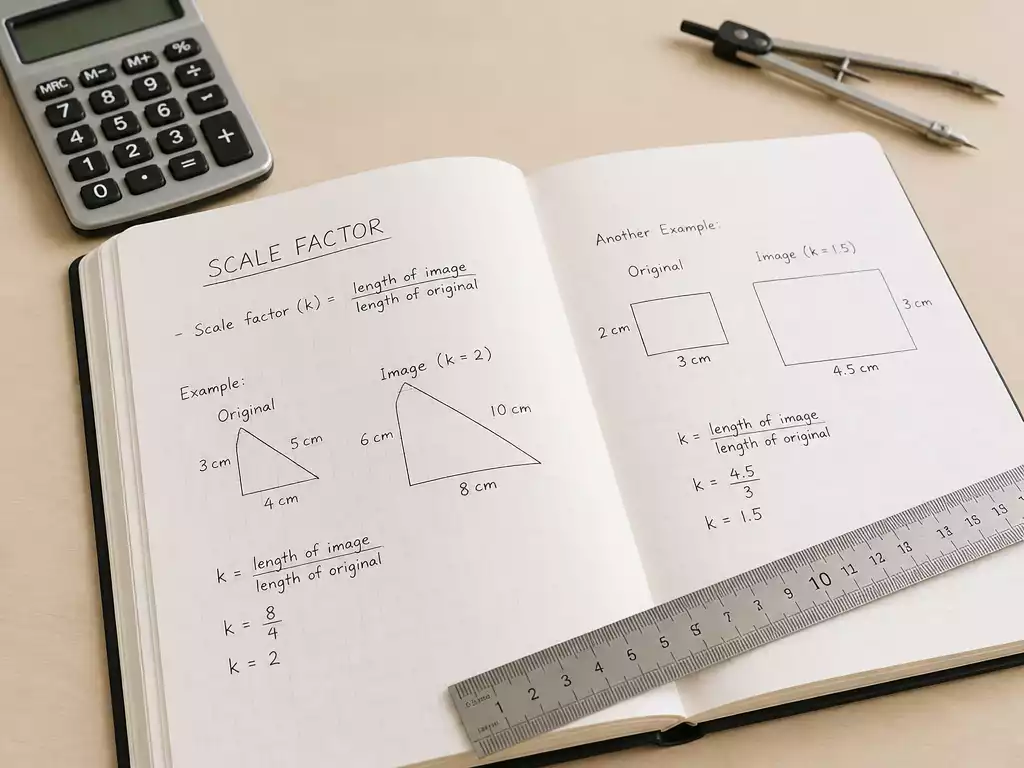
A scale factor is typically represented as a ratio, which can be expressed as a fraction. It indicates the proportional relationship between the dimensions of two similar shapes. For instance, if a triangle has a scale factor of 2, it means that every side of this triangle is twice as long as the corresponding side of another triangle.
- Enlarging shapes: A scale factor greater than 1 indicates an enlargement.
- Reducing shapes: A scale factor less than 1 indicates a reduction.
- Identical shapes: A scale factor of 1 indicates that the shapes are congruent.
Understanding these basic definitions is the first step in mastering scale factors. They help you visualize how objects relate to each other in terms of size and dimensions, whether in mathematics or everyday applications.

The Role of Scale Factor in Geometry and Real Life
Scale factors are not just theoretical; they have practical applications in many fields! In geometry, understanding scale factors allows us to create similar figures, which is crucial in various designs and constructions. For instance, architects often use scale factors to create blueprints of buildings, ensuring that the dimensions are accurately represented before construction begins.
- Architecture: Blueprints often utilize scale factors to represent buildings accurately.
- Engineering: Scale models are used to test the efficiency of designs before full-scale production.
- Art: Artists use scale factors to maintain proportion in their works when enlarging or reducing images.
By grasping the importance of scale factors in both geometry and real-life situations, we can enhance our problem-solving abilities and apply this knowledge across various disciplines!
Pro Tip
Did you know? When calculating the scale factor, it’s often helpful to maintain a clear visual reference. Use graph paper or digital design tools to accurately represent the original and scaled figures. This way, you can see the changes in proportion and adjust your calculations accordingly!
Frequently Asked Questions About Scale Factor
Q: What is a scale factor?
A: A scale factor is a number that describes how much a figure is enlarged or reduced. It represents the ratio of any two corresponding lengths in two similar figures.
Q: How do you determine if a scale factor indicates enlargement or reduction?
A: A scale factor greater than 1 indicates an enlargement, while a scale factor less than 1 indicates a reduction. A scale factor of 1 means the shapes are congruent (identical).
Q: What are some real-world applications of scale factors?
A: Scale factors are used in architecture for blueprints, in engineering for creating and testing scale models, and in art for maintaining proportion when resizing images.
Q: How is the scale factor calculated?
A: The scale factor is calculated using the formula: Scale Factor = New Dimension ÷ Original Dimension.
Q: What are common mistakes to avoid when working with scale factors?
A: Common mistakes include misidentifying corresponding sides between the two figures or reversing the numerator and denominator when calculating the ratio.
Recap of Scale Factor and Its Significance
As we wrap up our discussion on scale factor, it’s essential to highlight its significance in both geometric concepts and practical applications. Scale factor is not just a mathematical term; it’s a bridge that connects how we perceive dimensions in everyday life. Whether you’re resizing a picture, designing a model, or even cooking, understanding the scale factor can enhance your accuracy and confidence!
Remember, the scale factor allows us to translate sizes while maintaining proportions, which is crucial in various fields, including architecture, engineering, and graphic design. Here are some key takeaways:
- The scale factor can be calculated using the formula: Scale Factor = New Dimension ÷ Original Dimension.
- It plays a significant role in understanding ratios and dimensions in similar figures.
- Both area and volume scale factors differ fundamentally, impacting how we calculate and visualize space.
- Common mistakes often stem from misidentifying corresponding sides or reversing numerator and denominator.
Emphasizing these points aids in solidifying your grasp on the concept. As you apply this knowledge, you will find yourself navigating through both academic and real-world scenarios with greater ease!
Encouragement to Apply Your Knowledge
Now that we’ve unpacked the intricacies of scale factor, I encourage you to experiment with your newfound knowledge! There are endless opportunities to apply scale factor in everyday situations. From adjusting a recipe for a party to resizing images for a presentation, the possibilities are vast!
Consider trying these practical steps:
- Start with simple shapes and practice calculating the scale factor by enlarging or reducing them.
- Apply the scale factor to real-life items, like furniture or room dimensions, to get a better sense of how it works.
- Engage in crafting or DIY projects using scale factor to design models or layouts accurately.
Your journey with scale factor doesn’t have to end here! I invite you to share your insights or any questions you have about scaling techniques. Whether it’s a challenge you’ve faced or a success story, your experiences can enrich the learning for everyone!
Recap of Key Points
Here is a quick recap of the important points discussed in the article:
- The scale factor describes how much a figure is enlarged or reduced, indicating the ratio of corresponding lengths.
- A scale factor greater than 1 indicates enlargement, less than 1 indicates reduction, and equal to 1 indicates congruence.
- Scale factors are crucial in fields such as architecture and engineering for creating accurate designs and models.
- The formula for calculating the scale factor is: Scale Factor = New Dimension ÷ Original Dimension.
- Common mistakes include misidentifying corresponding sides or reversing the numerator and denominator in calculations.





