
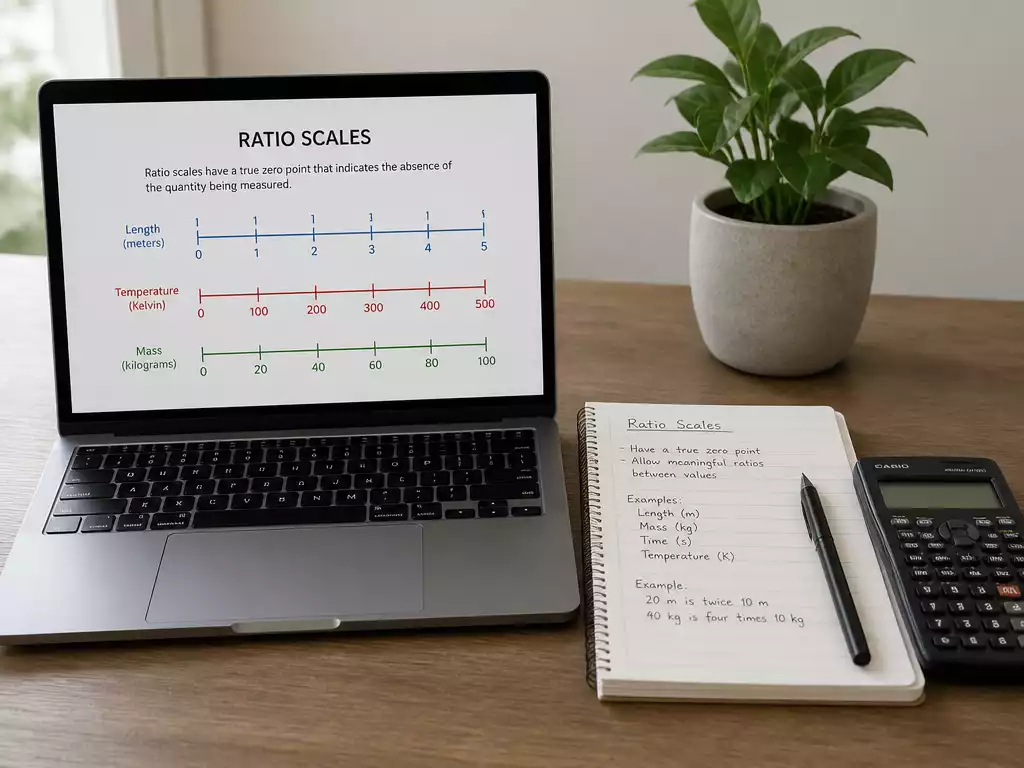
Have you ever considered how critical the concept of measurement is in our daily lives? Understanding ratio scales can transform the way you interpret data and make decisions.
What You Will Learn
- A ratio scale includes a true zero point, indicating the absence of the quantity being measured.
- Ratio scales allow for all mathematical operations, enabling meaningful comparisons and calculations.
- Equal intervals between values in ratio scales provide consistent and interpretable data.
- Understanding ratio scales enhances your skills in data analysis across various fields like economics and health sciences.
- The concept of true zero is essential for accurate statistical analysis and interpretations.
- Common tools for analyzing ratio scale data include SPSS, R, and Excel, each offering unique advantages.
Fundamentals of a Ratio Scale
When diving into the world of measurement, it’s crucial to grasp the concept of a ratio scale. A ratio scale is a quantitative measurement scale that possesses a true zero point, allowing for a full range of mathematical operations. This means that not only can we add and subtract values, but we can also multiply and divide them, leading to meaningful ratios. In essence, ratio scales provide a way to measure things like weight, height, or income, where the zero point indicates the absence of the quantity being measured.
What sets a ratio scale apart from other scales is its unique characteristics. Unlike nominal or ordinal scales, which categorize data without a true numeric value, ratio scales allow for consistent, quantifiable comparisons. This makes them essential in fields like research and statistics, where precise data representation is key!

What is a Ratio Scale and How Does it Work?
A ratio scale is fundamentally built on the principle of having equal intervals between values, along with a true zero point. For instance, if we take a scale measuring weight in kilograms, zero kilograms means no weight at all. This true zero is what makes ratio scales incredibly powerful, as it provides a context for calculating proportions. This functionality is crucial for many types of analysis, especially in fields like economics and health sciences.
- True Zero Point: Indicates the absence of the quantity being measured.
- Equal Intervals: The difference between values is consistent and meaningful.
- All Mathematical Operations: Allows for addition, subtraction, multiplication, and division.
Understanding how a ratio scale operates can enhance your ability to interpret data correctly. Whether you’re analyzing survey results or scientific measurements, the clarity and precision of a ratio scale help ensure that you’re making informed decisions.
The Importance of True Zero in Ratio Scales
The concept of a true zero is significant, as it fundamentally changes how we interpret data. On a ratio scale, zero signifies the complete absence of a value, which is not the case in interval scales, where zero is just another point on the scale. For example, a temperature of zero degrees Celsius does not imply the absence of temperature; it’s merely a point on the temperature scale. In contrast, a weight of zero kilograms indicates no weight whatsoever!
This distinction is essential when it comes to statistical analysis. Having a true zero allows for meaningful ratios and comparisons, such as saying that 20 kg is twice as heavy as 10 kg. Without this concept, many statistical operations would lose their significance. In our work at [Your Business Name], we often emphasize the importance of understanding these fundamental concepts to help our clients make better data-informed decisions.
Pro Tip
Did you know? When working with ratio scales, it’s beneficial to visualize your data through graphs or charts. This not only aids in better interpretation but also helps in identifying trends or outliers that might affect your analysis. Consider using scatter plots or bar charts to represent your ratio scale data effectively!
Summarizing the Significance of Ratio Scales
To wrap up our exploration of ratio scales, it’s essential to recognize their unique characteristics and practical applications. Ratio scales are vital for measurements where zero signifies the absence of the quantity being measured. For example, height, weight, and income all utilize this scale, allowing for meaningful mathematical operations like addition, subtraction, multiplication, and division.
Additionally, the flexibility of ratio scales makes them a powerful tool in various fields, including research, analytics, and statistical reporting. By understanding the nuances of this measurement scale, you can enhance your data analysis and interpretation skills significantly!
- True Zero: Ratio scales have a true zero point, which is crucial for accurate representation.
- Mathematical Operations: You can perform a wide range of calculations with ratio data.
- Real-World Relevance: Ratio scales are used across multiple disciplines, providing clear insights into data trends.
In summary, ratio scales not only facilitate robust data collection but also enhance the clarity and precision of your analysis!
Engaging with Ratio Scales: Your Next Steps
Now that you have a solid understanding of ratio scales, it’s time to put this knowledge into practice! Whether you’re conducting research, designing surveys, or analyzing data, incorporating ratio scales can significantly improve the quality and reliability of your findings. Don’t hesitate to experiment with these concepts in your own projects!
Remember, the more you engage with ratio scales in real-world applications, the more intuitive they become. This experience will empower you to make informed decisions based on quantitative data and enhance your analytical capabilities, ensuring you achieve your research goals!
Frequently Asked Questions About Ratio Scales
To further clarify the concept of ratio scales, here are some frequently asked questions:
- What is the primary characteristic that defines a ratio scale? The defining characteristic of a ratio scale is the presence of a true zero point, which signifies the complete absence of the quantity being measured.
- Can all mathematical operations be performed on ratio scale data? Yes, ratio scales allow for all mathematical operations: addition, subtraction, multiplication, and division, making them highly versatile for statistical analysis.
- How do ratio scales differ from interval scales? The key difference lies in the true zero point. Interval scales (like Celsius or Fahrenheit) have arbitrary zero points, while ratio scales (like Kelvin, height, or weight) have a true zero point that indicates the absence of the measured attribute.
- Why is a true zero important in data analysis? A true zero point is crucial because it allows for meaningful ratios and proportional comparisons. For example, you can accurately say that something is “twice as heavy” when using a ratio scale.
- What are some real-world examples of ratio scales? Common examples include height, weight, age, income, sales figures, and Kelvin temperature.
Exploring Statistical Software for Ratio Scale Analysis
When it comes to analyzing ratio scale data, using the right statistical software can make a world of difference. Here are some popular tools that I recommend:
- SPSS: Ideal for beginners, SPSS provides user-friendly interfaces for analyzing data, including ratio scales.
- R: A powerful programming language, R offers extensive packages for statistical analysis and visualization.
- Excel: Widely accessible, Excel features functions that are perfect for performing calculations on ratio data.
Each of these tools has its strengths, so consider your specific needs when choosing the right software for your analysis. By leveraging these resources, you’ll be well-equipped to conduct insightful analyses using ratio scale data!
Recap of Key Points
Here is a quick recap of the important points discussed in the article:
- True Zero Point: Ratio scales have a true zero point, signifying the absence of the quantity being measured.
- Equal Intervals: The difference between values on a ratio scale is consistent and meaningful, facilitating accurate comparisons.
- All Mathematical Operations: Ratio scales allow for addition, subtraction, multiplication, and division, enabling meaningful analysis.
- Real-World Applications: Ratio scales are crucial in fields like research, economics, and health sciences, providing clarity in data interpretation.
- Statistical Analysis: Understanding ratio scales enhances your ability to conduct meaningful statistical analyses and make informed decisions.